Using draft beer dispensers correctly
Published on February 8, 2023

When we go to a restaurant, beer hall or microbrewery, we expect to drink a draft beer (unpasteurized beer) that is crystal clear — when filtered — served at the right temperature, with a nice head of foam. Draft beer comes from the breweries in stainless steel kegs, in good quality condition. Unpasteurized beer can also be served directly from the microbrewery's tanks (filtered or not).
But at the point of sale (beer halls, bars, restaurants, etc.), that quality is not always kept. Even the most modern and revolutionary dispensing installation loses its efficiency when it is handled improperly or when cleaning and disinfection are not done properly.
The draft dispensing system
The dispensing system has a double function: channeling the compression gas (carbon dioxide) into the keg and, as a result, carrying the beer out to the dispensing tap.
The carbon dioxide (CO2) from the cylinder enters through the check valve of the spear, and through it into the keg, where it exerts a constant top-down pressure on the beer's surface. This prevents the loss of the gas held in the beer and pushes the beer up the spear as soon as the tap is opened. For the beer to rise from the keg to the tap without losing carbon dioxide, a compressed gas (carbon dioxide or nitrogen) is indispensable. Compressed air is not suitable for this. Even filtered, it oxidizes the beer and changes its organoleptic stability (aroma, taste), its physical-chemical stability (color) and its foam. The carbon dioxide supplied by the breweries is the ideal gas for dispensing beer in optimal conditions, since it is generated by the wort itself during fermentation.
There is no fixed rule for the pressure to be used, because it depends on a number of factors:
- CO2 content of the beer
- Storage temperature
- Choice of tap (type)
- Height of the line
- Length of the line
- Internal diameter of the line
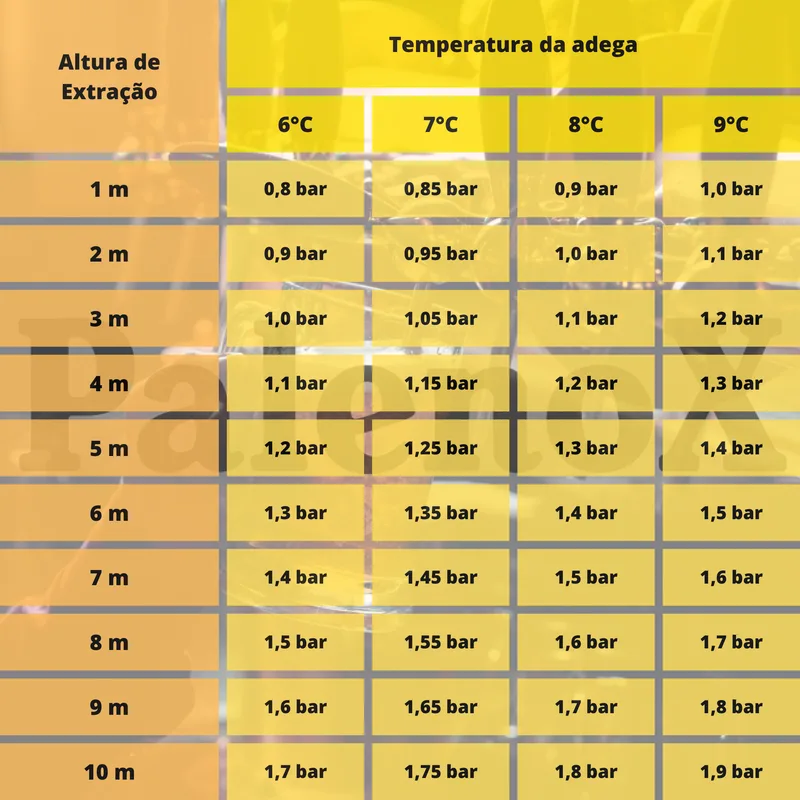
The following table shows the relationship between the cellar (cold room) temperature in degrees Celsius, the dispensing height in meters and the recommended pressure (in bar).
Carbon dioxide cylinder
Carbon dioxide cylinders can be made of steel or aluminum and come in several capacities (3, 8, 10 or 30 kg). The gas is usually supplied at a pressure of 50 kg per square centimeter (50 kgf/cm2) at a temperature of 15°C. The pressure therefore varies with temperature. Pay attention to a very important fact that is usually ignored in practice: when CO2 cylinders are stored at 15°C, the carbon dioxide is in a liquid state at that temperature. But if the temperature rises to 31°C, the liquid spontaneously turns into gas and the pressure rises to 450 kgf/cm2 (!), which can cause an explosion (if the safety valve, set to act at 160 – 180 kgf/cm2, happens to be faulty and does not act).
Do not expose cylinders to heat, and avoid violent knocks or falls, which can cause explosions! When in service, cylinders must always be secured with a safety ring or chain fixed to the wall or counter. The CO2 cylinder outlet valve is at the top. When not in use, keep the outlet valve covered by a valve protection cap ("helmet"), so that falls or knocks do not damage it or, in more serious cases, shear it off. If the room where cylinders and kegs are stored is closed, provide forced ventilation to eliminate any build-up of carbon dioxide, which is deadly above certain concentrations. Installing a suitable gas detector for early warning of leaks is recommended.
The pressure reducing valve
To set and control the carbon dioxide pressure suitable for dispensing, a "pressure reducing valve" with a pressure gauge, regulator and safety valve is fitted to the outlet of the CO2 cylinder. Under no circumstances should the keg be pressurized directly, without a reducing valve, as this risks an explosion.
Gas lines
Carbon dioxide lines should be sized for a working pressure of 1 to 3 bar, and the fittings must allow a secure connection with no risk of leaks, which could injure the operator. Gas lines must not pass any foreign odor or taste to the beer.
The keg
Kegs are made of stainless steel and come in capacities from 10 to 50 liters. They are equipped with a complex spear with seals and check valves. Through this spear, the beer flows to the dispenser when subjected to the necessary carbon dioxide pressure.
Fitting the keg coupler is simple: first connect the beer and carbon dioxide lines to the coupler. Then remove the protective seal from the keg neck and connect the coupler, turning it to the right to lock it.
Only then lower the lever, allowing the beer and carbon dioxide to pass. Even at night or when we are not serving, we should not shut off the carbon dioxide, otherwise the beer risks going flat. Once opened, a keg should be finished as soon as possible.
Dispensing problems
When problems occur while serving, we must stay calm, even if the place is full and the customer complains. Several factors can prevent us from serving the beer, as shown below:
The beer does not flow
– The keg is empty – The valves are blocked – The beer line is frozen – The beer line is obstructed (e.g. by sponge balls) – The carbon dioxide cylinder is empty – The carbon dioxide line is leaking (check with soapy foam) – The beer line is kinked – The carbon dioxide (CO2) pressure is too low – The keg coupler is fitted incorrectly – The valve at the keg outlet is closed
The beer comes out cloudy
– The beer is too cold – The beer lines are not clean – The dispensing system has too much pressure – The beer warms up in the line – Carbon dioxide entering directly into the beer line. The beer is foaming too much – The carbon dioxide pressure is too high – The beer is too warm – The glasses are too warm – The beer is being forced out of the line – The beer warms up in the line – The beer line is kinked – Beer stone deposits in the line (cleaning!) – The CO2 pressure reducing valve is faulty or has been tampered with
The beer has too little foam
– The beer is too cold – The carbon dioxide pressure is too low – The carbon dioxide supply is being interrupted – Carbon dioxide loss through leaking fittings and seals – The glasses were not rinsed well – Products that destroy foam were used to wash the glasses
Authors:
Matthias R. Reinold – Certified Brewmaster (V.L.B – T.U. Berlin)