Palecarbo: In-Line Carbonation Technology to Optimize Beverage Production
Published on November 20, 2026
*Discover the solution developed by Palenox to make CO₂ incorporation faster, more homogeneous, and more controlled, contributing to production efficiency in breweries, kombucha producers, and other beverage industries.*
How much time does your industry spend on carbonation?
In the beverage industry, every stage of the production process influences production capacity, equipment utilization, and operating costs.
Carbonation is one of these stages. Although essential to the characteristics of many beverages, it can become a bottleneck when it requires long processing times or keeps tanks occupied longer than necessary.
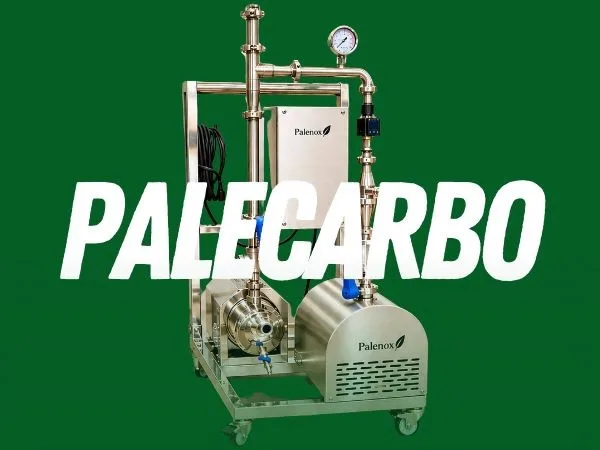
With this challenge in mind, *Palenox developed Palecarbo, an in-line carbonator that incorporates and homogenizes CO₂ directly into the beverage as it flows through the equipment.*
This technology offers an alternative to conventional carbonation processes, with applications in beer, kombucha, soft drinks, mixed beverages, and other carbonated drinks.
How does conventional carbonation work?
There are different methods used by the beverage industry to incorporate CO₂ into beverages.
Among the most common are tank pressurization with CO₂, the use of porous carbonation stones, and the installation of these devices in recirculation systems.
Although widely used in the market, the efficiency of each method depends on factors such as temperature, pressure, flow rate, contact time, and gas distribution throughout the liquid.
Under certain conditions, carbonation can require extended processing times, keeping tanks occupied and making it difficult to schedule new production batches.
Additionally, some of the supplied CO₂ may migrate into the tank's headspace, making it important to evaluate how effectively the gas is utilized throughout the process.
What makes Palecarbo different?
Palecarbo's main differentiator lies in how CO₂ is incorporated into the beverage.
Rather than relying exclusively on gas dispersion inside a tank, the equipment injects CO₂ directly into the liquid flow and uses its own dispersion and homogenization system, developed by Palenox's engineering team.
The system combines a pump, flow monitoring, CO₂ injection control, and a dedicated device designed to promote efficient mixing between the gas and the beverage.
*The goal is to deliver a beverage with homogeneous carbonation at the equipment outlet, while respecting operating conditions and the desired CO₂ level.*
This feature creates new possibilities for organizing and optimizing the production process.
Flow-Through or Recirculation Carbonation
One of Palecarbo's key features is its operational flexibility.
*Flow-Through Carbonation*
The beverage is transferred from the source tank, passes through Palecarbo, and receives CO₂ as it flows through the equipment.
Depending on process conditions and the desired carbonation level, it can then be transferred to a buffer tank or directly to a compatible filling line.
When used, the buffer tank can be sized according to the filling line's supply requirements, without necessarily having the same capacity as the source tank.
*Recirculation Carbonation*
Palecarbo can also operate through recirculation, allowing the beverage to circulate through the equipment until the desired carbonation level is reached.
This option provides flexibility for industries with different tank configurations, production volumes, and operational routines.
The choice between flow-through and recirculation depends on the beverage characteristics and operating conditions.
Shorter Processing Times and Better Production Capacity Utilization
Reducing the time dedicated to carbonation can bring benefits that go beyond this specific stage.
When the process is faster, tanks can become available sooner for new batches, improving the utilization of the existing infrastructure.
This can create an opportunity to increase production capacity without necessarily investing in additional tanks.
The actual gains depend on each industry's operating conditions, but the principle is simple: *the less time equipment remains occupied by a process that can be optimized, the greater the potential for production flexibility.*
What About CO₂ Consumption?
Gas consumption also deserves attention.
Palecarbo was developed to promote CO₂ incorporation and homogenization directly into the beverage flow.
This feature can help reduce losses associated with inadequate gas dispersion and improve gas utilization, depending on operating conditions.
To determine actual savings, CO₂ consumption per volume of carbonated beverage must be compared, taking into account the same final carbonation level.
More than simply injecting gas, the objective is to use technology to make the process more efficient and controlled.
A Solution for Different Beverage Industries
Palecarbo was developed for manufacturers looking to improve the efficiency of their carbonation processes.
Applications include:
- Breweries and draft beer manufacturers;
- Kombucha producers;
- Soft drink and naturally carbonated beverage manufacturers;
- Mixed beverage industries;
- Wine-based beverage manufacturers and other producers whose products are compatible with the technology.
The equipment is available in versions with nominal capacities of *500 L/h and 1,000 L/h*, allowing manufacturers to evaluate the configuration that best suits their production requirements.
Technology Developed by Experts Who Understand the Process
With in-house engineering expertise and experience in developing equipment for the beverage industry, Palenox focuses on solutions that contribute to its customers' operational efficiency.
Palecarbo represents this philosophy: developing technologies that address real production needs, taking into account processing time, resource utilization, and installed capacity.
*Does your industry still spend long periods carbonating beverages?*
Discover Palecarbo and talk to the Palenox team about how this technology can be applied to your production process.
*Palenox — Transforming Processes. Driving Results.*