The most common methods for dry hopping beer
Published on September 23, 2023
The most common methods for dry hopping beer
Matthias R. Reinold
Dry hopping is a technique of adding hops to beer that brings different aromas and flavors. Dry hopping first appeared in England between the 18th and 19th centuries and basically consisted of adding hops to the wooden casks in which beer was stored and transported.
There are several methods for dry hopping beer. The simplest, still widely used, is placing a perforated fabric bag ("hop bag") with hop pellets (or cones) inside the beer. There is also the option of a stainless steel hop bag, which is easy to clean.
Another method is the "bazooka": a stainless steel tube (with fittings at both ends, a shut-off valve and a carbon dioxide injection nozzle) into which the hops are loaded. The tube is connected to the top of the fermentation/maturation tank (FMT) and the hops are injected into the tank.
Transferring between tanks is also possible, but it has a series of drawbacks (high carbon dioxide consumption, an extra tank tied up in the process, high beer losses from draining/purging, etc.), so it is not recommended.
Dynamic systems, such as an external tank for dissolving and dosing hops with a centrifugal pump, are also used, but they need a suitable pump to avoid layering in the tank and/or oxygen pick-up during circulation. They also have higher beer losses due to purging.
Another dynamic system is one where the hops are held in a perforated basket (lined with screen) inside a (pressurized) vessel and the beer circulates through it. This makes better use of the hops, allowing much smaller amounts to be used. Contact time is also reduced from days to a few hours.
Dynamic dry hopping (DDH)
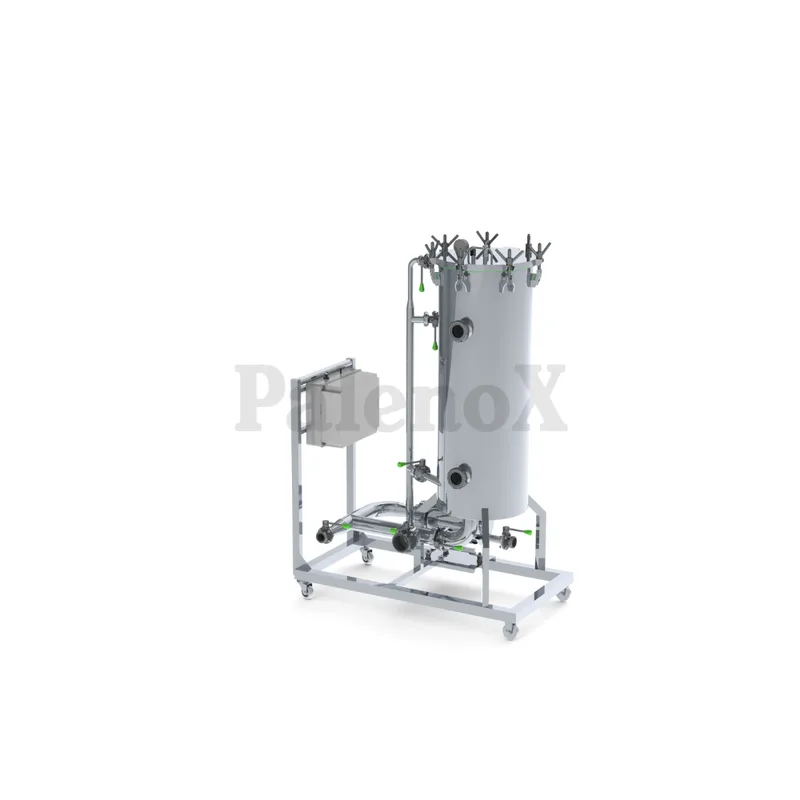
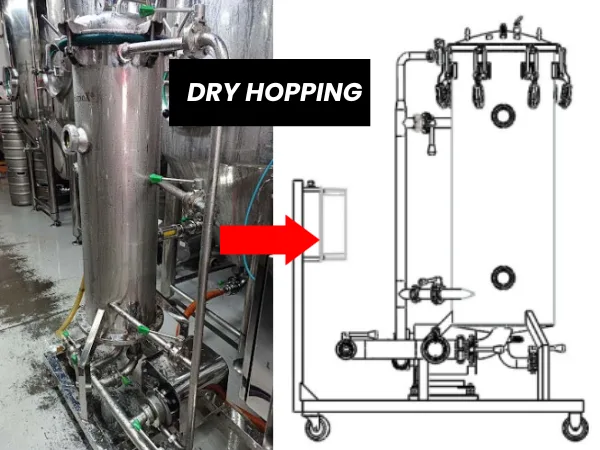
Recently a new dosing system has come into use, in which the hops are dosed into a cylindrical stainless steel vessel with a filter element in the center ("candle") and tangential inlets. The hops are held by the filter element while the beer circulates between the beer tank (FMT) and the dry hopping system.
The dynamic dry hopping (DDH) system dissolves hop pellets in beer; it leads to more consistent results and ensures intense contact between the beer and the hops.
This results in more economical dry hopping, which also means lower costs. In addition, your beer gets a more pleasant and smoother hop body.
Benefits:
– The circulation time needed depends on the desired aroma intensity and the type of hop, and can range from 4 to 12 hours. Fast and efficient extraction of the hop aroma and essential oils compared with the conventional method: at most 12 hours versus 4 to 5 days; – Optimized aroma extraction through the tangential inlet and flow control; – Less extraction of bitterness and polyphenols relative to the aromas extracted; – Practically zero beer loss; – An integrated filter element holds back hop particles and makes cleaning the fermentation/maturation tanks simpler. – System built entirely in AISI 304 stainless steel, equipped with a sanitary centrifugal pump with frequency control, pressure control by gauge, safety valve and CO2 inlet. The system is cleaned by CIP (spray ball). – Operation is simple and easy — the DDH system can be flexibly integrated into an existing cellar. – Other additions such as spices and fruit can also be dosed. There is no oxidation of the product: the tanks are kept under CO2 pressure. The equipment can be used for both dry hopping and hop back. – Hop savings: standard doses between 200 g/hl and 400 g/hl.
Matthias R. Reinold – Certified Brewmaster (V.L.B – T.U. Berlin)